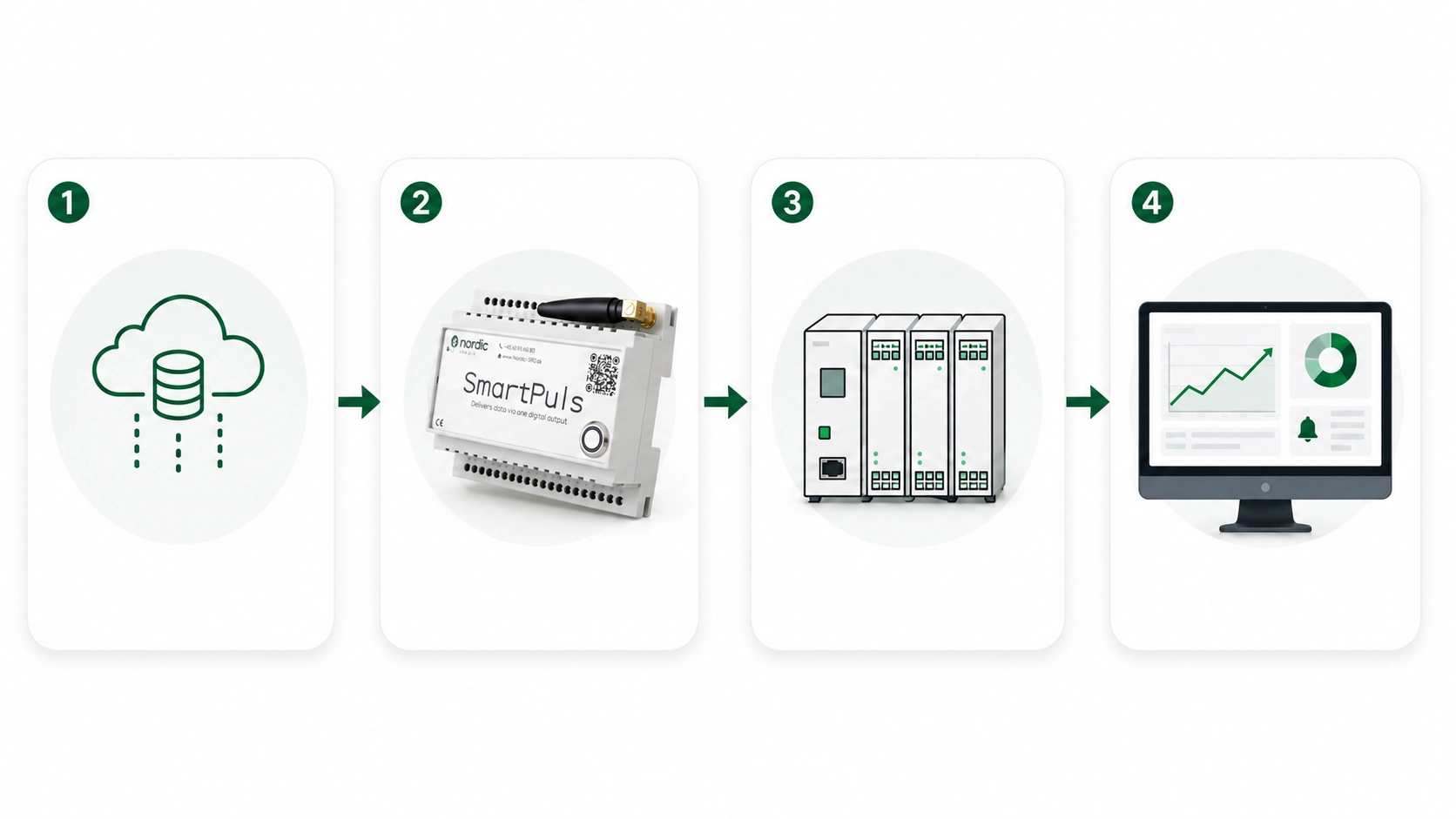
SmartPuls gives your PLC access to electricity prices, temperature, and precise time – without network connections, API integrations, or complex setup.
What is the box?
SmartPuls is a small unit mounted directly on the DIN rail inside the electrical panel.
It has a built-in SIM card and automatically delivers data to your control system – without the need for network access, IT involvement or complex setup.
All communication takes place via a single 24VDC digital output, which is connected to a PLC input.
This makes the solution simple to install and easy to use in existing automation systems.
With SmartPuls, you can easily start and stop equipment, optimize operation and document energy consumption – fully automatically.
Electricity prices in 15-minute intervals – today and tomorrow
Weather data for the local location via GPS – hour by hour, today and tomorrow
CO₂ intensity in g CO₂/kWh every 5 minutes – for display in SCADA and documentation in ESG reporting
Current time – used as a precise time server
Error signal in case of missing data
Simple, secure and NIS2-compatible data delivery
Get a quick overview of how much you can save with SmartPuls.
Adjust the sliders and see how you can reduce electricity costs by avoiding the most expensive periods of the day.
Quick start:Example values — adjust them to match your own plant
Daily saving€34
Monthly saving€1.008
Annual saving€12.096
Estimated CO₂ saving/year
0 kg
That is roughly equivalent to a passenger car driving almost twice around the world.
Payback is based on SmartPuls Complete 4G at 5.450 kr. plus 12 months of subscription at 99 kr./month — excl. VAT.
CO₂ estimate based on an assumed difference of 50 g CO₂/kWh between high- and low-price periods — the actual difference varies over time.
How SmartPuls targets the lowest-price periodsIllustrative profile — updates with your settings above
0006121824
Selected operating periodsPeriods without planned operation
With your settings, the plant is scheduled to run during the 16 lowest-price periods of the day.
SmartPuls is available in two 4G versions. Both are DIN-rail mounted and deliver data to the PLC through a single 24 VDC digital signal.
Most complete
SmartPuls Complete 4G
Electricity prices and local weather data directly to PLC and SCADA.
5.450 kr.per unit, excl. VAT
+
99 kr./md.subscription per unit
Electricity prices in 15-minute intervals – today and tomorrow
4 selectable datasets — freely combined across available data sources
GPS positioning for precise local weather data
SMS notification in case of errors
Weather data
SmartPuls Weather 4G
Local weather data directly to PLC and SCADA.
4.450 kr.per unit, excl. VAT
+
99 kr./md.subscription per unit
4 selectable datasets — freely combined across available data sources
GPS positioning for precise local weather data
SMS notification in case of errors
Subscription
99 kr./month per unit
The subscription includes the ongoing data connection and operation of SmartPuls.
SIM card
Data connection
Software updates
Operational monitoring
Accessories
External 4G antenna
450 kr. excl. VAT
External 4G antenna including 3 metres of cable for installations where signal conditions require an external antenna.
Step 1 · Build your own example
Choose your 4 datasets
First click the slot you want to change, then choose a data source below.
The datasets can be mixed freely — for example temperature, humidity, Kamstrup data and CO₂ intensity in the same SmartPuls.
You are changing dataset 1. Choose a data source below.
Example values
Temperature
Today
Tomorrow
Step 2
Choose data for Dataset 1
Select the data you want to insert into Dataset 1. Your selection will appear in the highlighted dataset above.
Weather data
Choose a value as one of the 4 datasets
Weather data is delivered as hourly values for today and tomorrow.
Other data
Meter, sensor, pulse and market data
Click a card to place the data source in the active slot above.
i
The examples illustrate the SmartPuls data structure. Actual values and available fields depend on the selected data source and integration.
Which SmartPuls fits your plant?
We can help determine the right model, data requirements and integration with your PLC and SCADA solution.
All prices exclude VAT. All SmartPuls units require a subscription of 99 kr./month per unit.
NIS2-oriented OT zone
API
SmartPuls
PLC
SCADA
Electricity prices
Weather data
CO2/kWh
Tid
Retrieves electricity prices, weather data, CO₂ data and time from external data sources.
Converts the data into a simple digital signal.
The PLC receives the signal through a digital input.
The data is displayed and used for control, alarms and optimisation.
SmartPuls delivers external data to PLC and SCADA — without direct network access to the automation system.
Installation in practice
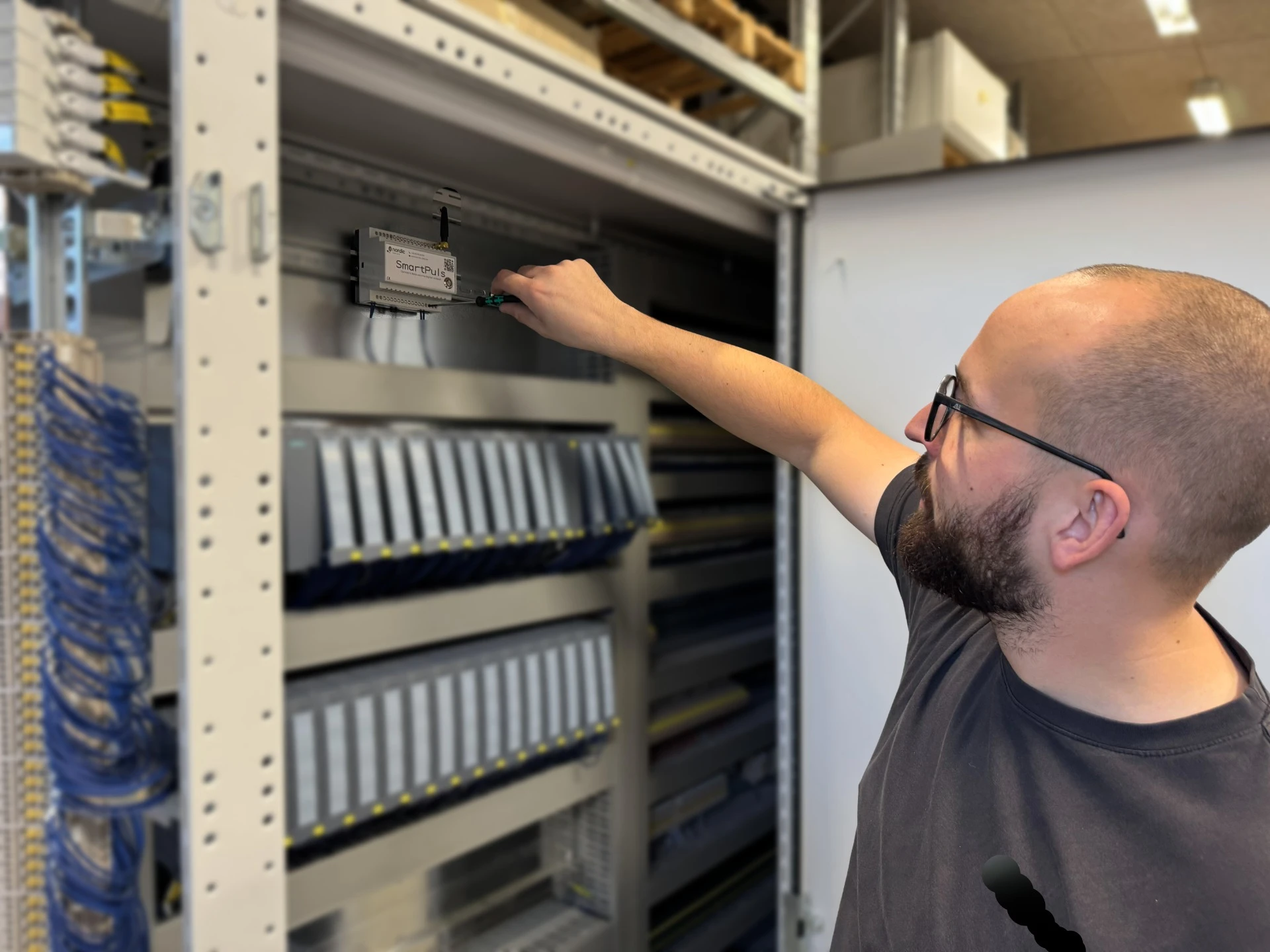
Simple installation in the control cabinet
SmartPuls is mounted directly on the DIN rail and connected to the PLC through one 24 VDC digital signal.
The built-in 4G connection means no network access to the automation system is required.
Direct DIN-rail mounting
One 24 VDC digital signal to the PLC
No network access to PLC or SCADA
Suitable for both new installations and integration into existing control cabinets.
Examples from different plant types
See how SmartPuls can be used in district heating, biogas and wastewater applications.
Start and stop electric boilers and heat pumps based on electricity prices — reduce operating costs during high-price periods.
Dynamic load control: Scale heat pumps, pumps or electric boilers in steps according to price level, e.g. 100% / 50% / 0%.
Electricity consumption logging: Get an accurate picture of when and how much electricity is used — and what it costs.
Accurate electricity cost calculation: Combine operating times and electricity prices to analyse the efficiency of individual machines or processes.
Automatically switch between heat-producing units based on electricity prices — for example between heat pumps and gas or wood-pellet boilers.
Time-based operation: Synchronise the PLC with an accurate clock — important for scheduled switching and documentation.
Temperature-based control: Adjust heat-pump start, stop and load steps according to both price and outdoor temperature.
Gas engine control: Start and stop gas engines based on current electricity prices and maximise the economics of power generation.
Compressors and pumps: Optimise operating times for energy-intensive equipment — run during low-price periods and avoid high-price periods.
Gas storage: Delay the use of stored biogas until periods with higher electricity prices, when generation provides the best return.
Time-controlled PLC operation: Synchronise the PLC system with the built-in time server and avoid deviations in control logic.
Automated energy management: Activate functions automatically during low-price periods — without manual intervention.
Tank mixing: Reduce or postpone mixing during high-price periods where the process allows it — and save energy.
Weather-compensated operation: Use local temperature data to adjust strategies such as gas-engine loading or heat recovery.
Pump control: Adjust pumping in sewer systems and pumping stations according to electricity prices and postpone non-critical pumping to low-price periods.
Mixing and aeration: Run aeration tanks and mixers more intensively when electricity is cheap and reduce operation during high-price periods.
Sludge dewatering and transport: Schedule dewatering, polymer dosing and sludge pumping during low-price periods.
Carbon filters and UV systems: Adjust operating times for UV disinfection and carbon filters where operationally appropriate.
Heat pumps: Optimise wastewater-based heat-pump operation according to price level and reduce energy costs.
Temperature-controlled aeration: Adjust mixer and aerator operation based on water temperature and outdoor temperature.
Do you want to see if SmartPuls is a good fit for your plant?
We are happy to have a concrete discussion about the possibilities, the savings, and how SmartPuls can be used in your PLC control.